

Is There A Red Light Camera At Knight And Woodhaven Roads

City Quango has canonical the expansion of the Blood-red Light Camera Program. Installation work is ongoing. View electric current locations.
A Red Light Camera (RLC) is an automated system that detects and captures images of vehicles entering an intersection in spite of the traffic signal indicating cerise (during the red stage). It is designed to work in tandem with other Vision Naught methods and strategies, including road design changes, public didactics campaigns and traditional police enforcement. The RLC program is focused on altering driver behaviour to decrease scarlet-calorie-free running and increment condom.
Images are reviewed by Provincial Offence Officers and then tickets are issued to the owner of the vehicle regardless of who was driving. Upon conviction, the but penalty is a fine – no demerit points will be issued nor will the registered owners' driving record exist impacted.
Locations are selected through a data-driven approach that considers collision information.
Information on paying your Provincial Offence or disputing your Provincial Offence may be found by visiting the City of Toronto's Court Services.
If you lot received a ticket in the mail for running a reddish low-cal, you tin can view the images of your vehicle using the City's Court Case Expect Upward application.
Pay Your Ticket Online
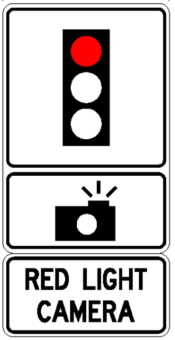 Signs volition be posted at signalized intersections with an RLC system. Motorists must obey the indicate at all signalized intersections and be prepared to come to a consummate end when faced with a red point.
If a vehicle is detected past the RLC system for red-light running, the registered owner of the vehicle will receive a ticket regardless of who was driving. The full payable amount includes a Set Fine nether the Provincial Offences Act ($260), a victim fine surcharge ($60) and applicable court costs ($five). No demerit points volition be issued by the Ministry of Transportation and no one's driving record will be impacted.
In selecting RLC sites, a two-staged process was used based on best practices and provincial guidelines.
Phase 1: First, an initial screening of all signalized intersections to identify and prioritize sites based on the following data:
- Killed or Serious Injury (KSI) collisions involving pedestrians
- Killed or Serious Injury (KSI) angle collisions
- Killed or Serious Injury (KSI) collisions involving cyclists
- Angle collisions
- Pedestrian collisions
- Cyclist collisions
- Requests from the Toronto Police Service and the public
Stage 2: One time the sites were prioritized, a manual review of the site was conducted which included the following considerations:
- Necessary regulatory signage
- No obstructions or impediments to the RLC system
- Adequate boulevard space to accommodate the RLC system
- No construction conflicts
To submit a request for RLC, please fill in the online form.
Statistics
View the annual number of charges laid in Toronto past their location.
Last published: Jan 2022
History
- Apr xxx, 2020: City Council canonical the award of the RLC Expansion Contract to Traffipax LLC
- June 26, 2018: Metropolis Council requested to double the number of cherry-light cameras and evaluate the feasibility of significantly expanding the Red Lite Camera program as part of the Vision Zero Route Safe Programme.
- May 24, 2017: City council authorized the continued performance of lxx RLCs that were previously scheduled for decommissioning
- September 30, 2015: Urban center Council approved the award of the Phase 3 RLC Contract to Traffipax LLC
- February 19, 2014: City Council authorized the issuance of a Request for Proposal, in conjunction with other partnering municipalities to operate RLCs
- Feb twenty, 2013: Urban center Council authorized agreements with the Ministry building of Transportation and Partnering Municipalities to operate the RLC Joint Processing Centre
- November 29, 2011: City Quango adopted various recommendations from the Accountant General in respect to the RLC program
- June fourteen, 2011: City Council approved the extension of the RLC Contract to Traffipax LLC
- Jan 2010: The Province of Ontario increased the fine for reddish light running from $180.00 to $325.00, recognizing that seriousness and often consequences of ruby calorie-free running
- April 28, 2008: City Council approved the extension of the RLC Contract with Affiliated Calculator Systems (formerly Lockheed Martin Ims Canada Inc. and at present Xerox) and agreements with the Ministry of Transportation
- May 2006: City Council approved the extension of the RLC Contract with Affiliated Computer Systems (formerly Lockheed Martin Ims Canada Inc. and at present Xerox). Urban center Council likewise authorized a new RLC contract with Traffipax LLC
- July 2004: Urban center Council approved the extension of the RLC Contract with Affiliated Computer Systems (formerly Lockheed Martin Ims Canada Inc. and at present Xerox)
- September 2003: City Council requested the Authorities of Ontario to extend (Bill 102, as amended by Bill 149) for an indefinite period
- June 2003: Urban center Council canonical the continued operation of the RLC Plan from November 2003 to November 2004; approved the extension of the RLC Contract with Affiliated Figurer Systems (formerly Lockheed Martin Ims Canada Inc. and at present Xerox).
- November 19, 2002: Bill 149 received Royal Assent allowing municipalities to operate an RLC Plan until November 2004; later amended to an indefinite period
- July 2002: City Quango approved the connected performance of the RLC Programme from November 2002 to November 2003
- April 2002: City Council approved the award of the RLC Contract to Affiliated Computer Systems (formerly Lockheed Martin Ims Canada Inc. and now Xerox)
- February 2002: Urban center Council requested the Government of Ontario to extend Bill 102, to allow municipalities to continue to operate the RLC projection for an boosted ii years
- September 1999: City Council approved the deferral of the Crimson Light Photographic camera pilot project
- December 1998: Metropolis Quango authorized the tendering for the installation of RLCs at ten high-risk intersections on a pilot basis
- December 1998: the provincial government enacted Beak 102, Cherry Lite Cameras Pilot Projects Act, 1998, to allow designated municipalities to use crimson light cameras for upward to two years following date of proclamation
Source: https://www.toronto.ca/services-payments/streets-parking-transportation/traffic-management/pavement-markings/red-light-cameras/
Posted by: carpenterhanch1957.blogspot.com
0 Response to "Is There A Red Light Camera At Knight And Woodhaven Roads"
Post a Comment